|
Home - Fort Lauderdale/Miami |
 |
Desert Magazine January 2007 |
|
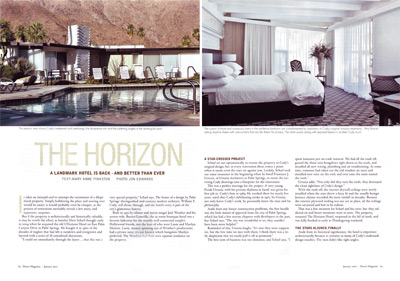
The Horizon: A Landmark Hotel Is Back--And Better Than Ever It takes an intrepid soul to attempt the restoration of a dilapidated property. Simply bulldozing the place and starting over would be easier; it would probably even be cheaper, as the process of renovation inevitably reveals a few nasty, and expensive, surprises. But if the property is architecturally and historically valuable, it may be worth the effort, as hotelier Dave Scharf thought early in 2004 when he acquired the old L'Horizon Hotel on East Palm Canyon Drive in Palm Springs. He bought it in spite of the decades of neglect that had left it rundown and overgrown and layered with a series of ill-considered alterations.
"I could see immediately through the layers...that this was a very special property," Scharf says. The bones of a design by Palm Springs' distinguished mid-century modern architect, William F. Cody, still shone through, and the hotel's story is part of the city's glamorous history. Built in 1952 by oilman and movie mogul Jack Wrather and his actress wife, Bonita Granville, the 22-room boutique hotel was a favorite hideaway for the socially well-connected couple's Hollywood friends, not the least of who were Lassie and Marilyn Monroe. Lassie, money-spinning star of Wrather's productions, had a private suite; it's not known which bungalow Marilyn preferred. The Wrathers had their own separate residence on the property.
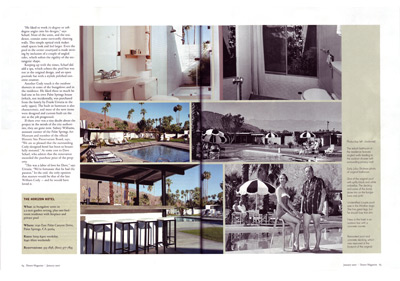
A Star-Crossed Project This was a perfect marriage for the project: A very young Frank Urrutia, with his pristine diploma in hand, was given his first job in Cody's firm in 1969. He worked there for nearly five years, until after Cody's debilitating stroke in 1972. So Urrutia not only knew Cody's work, he personally knew the man and his philosophy. Aside from any future construction problems, the first hurdle was the little matter of approval from the city of Palm Springs, which has had a few stormy chapters with developers in the past, but Scharf says, "The city was wonderful to us; they couldn't have been more helpful." Reminded of this, Urrutia laughs: "It's true they were supportive, but the first time we met with them, I think there was a little skepticism that we could pull it off as promised." The first item of business was site clearance, and Scharf says, "I spent $100,000 just on trash removal. We had all the roofs off, gutted the three-unit bungalows right down to the studs, and installed all new wiring, plumbing and air-conditioning. At some time, someone had taken out the old window air units and installed new ones on the roof, and over time the units ruined the roofs." Urrutia adds, "Not only did they ruin the roofs, they destroyed the clean sightlines of Cody's design." With the roofs off, the interior drywall ceilings were newly installed when the stars threw a hissy fit and the usually benign January climate recorded the most rainfall in decades. Because the exterior plywood roofing was not yet in place, all the ceilings were saturated and had to be redone. That was a low moment for Scharf and his crew, but they soldiered on and better moments were in store. The property, renamed The Horizon Hotel, reopened in the fall of 2006, and was fully booked as early as Thanksgiving weekend. The Stars Aligned, Finally "He liked to work 72-degree or 108-degree angles into his designs," says Scharf. Most of the units, and the residence, contain some outwardly slanting walls. This simple optical trick makes small spaces look and feel larger. Even the pool in the center courtyard is made inviting by inclusion of a couple of angled sides, which soften the rigidity of the rectangular shape. Keeping up with the times, Scharf did add a spa, which echoes the pool but was not in the original design, and an open poolside bar with a stylish polished concrete counter. Another Cody touch is the outdoor showers in some of the bungalows and in the residence. He liked these so much he had one in his own Palm Springs house (which, not incidentally, was purchased from the family by Frank Urrutia in the early 1990s). The built-in furniture is also characteristic, and most of the new items were deigned and custom built on the site as the job progressed. If there ever was a doubt about the project in the minds of the city authorities, they are gone now. Sidney Williams, assistant curator of the Palm Springs Art Museum and member of the official Historic Site Preservation Board, says, "We are so pleased that the outstanding Cody-designed hotel has been so beautifully restored." At some cost to Dave Scharf, who admits that the renovation exceeded the purchase price of the property. "This was a labor of love for Dave," says Urrutia. "We're fortunate that he had the passion." In the end, the only opinion that matters would be that of the late William Cody--and he would have loved it. |
||